
Pasco County Court Records After a Jail Arrest
An arrest in Pasco County puts a person in the jail and creates a booking record, but it does not by itself open a court case. The booking charges are what the arresting officer listed. The court record begins later, when the Office of the State Attorney for the Sixth Judicial Circuit reviews the arrest and decides whether to file charges. That circuit serves both Pinellas and Pasco Counties. Once charges are filed, the case opens and the Clerk of Court keeps the record.
So two records exist after an arrest, and they are easy to confuse. The booking and custody side lives on the jail roster, covered in jail inmate records, and booking photos are explained on the jail mugshots page. The court record is the set of charges the prosecutor actually filed, tracked through the case as it moves. The roster charge and the court charge can differ, which is why the court record matters once a case is underway.
How to Find Pasco County Court Records After an Arrest
Court cases in Pasco County are searched through the Clerk's Online Court Records Search, run on the Civitek system. The public can search without an account, while attorneys of record can apply for enhanced access. The booking and arrest detail stays on the jail roster, but the filed charges and their status live in the court index.
- Open the Online Court Records Search for Pasco County after reading the Clerk disclaimers.
- Choose Person Search or Case Search, then enter a last name or a case number.
- Open the case and read the charge list and the court type, such as felony or misdemeanor.
- Check each charge's code, level, and current status as the case moves.
The Clerk's court-records page below shows the search button and the attorney enhanced-access note.
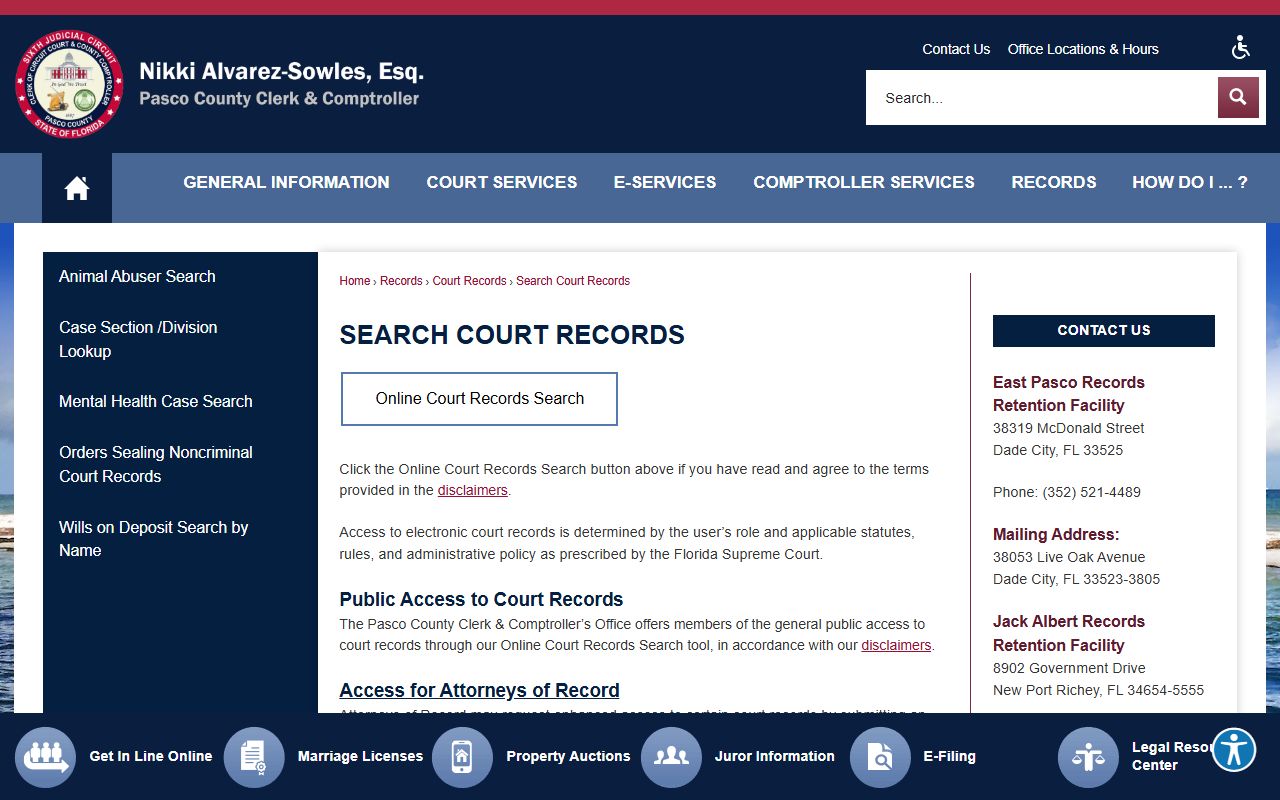
The portal uses Person Search and Case Search tabs and a set of court-type checkboxes. The ones tied most directly to a jail arrest are CF for felony and MM for misdemeanor, with CT criminal traffic, CO and MO ordinance, and TR or IN traffic and infractions also possible. A Cloudflare check appears before results load. For older or non-searchable files, the Clerk's public-records liaison and records-retention facilities handle requests.
State Attorney Review of Pasco County Arrests
The court record after an arrest does not exist until the prosecutor acts. The Sixth Judicial Circuit State Attorney's office says that after an arrest a case is submitted for review of the facts, the proof, whether the conduct is chargeable, the witnesses, and whether the case can be tried. Prosecutable cases are activated by filing a charging document. A case may also be declined for legal reasons such as insufficient proof.
The State Attorney homepage below serves both Pinellas and Pasco Counties and lists the office's role.
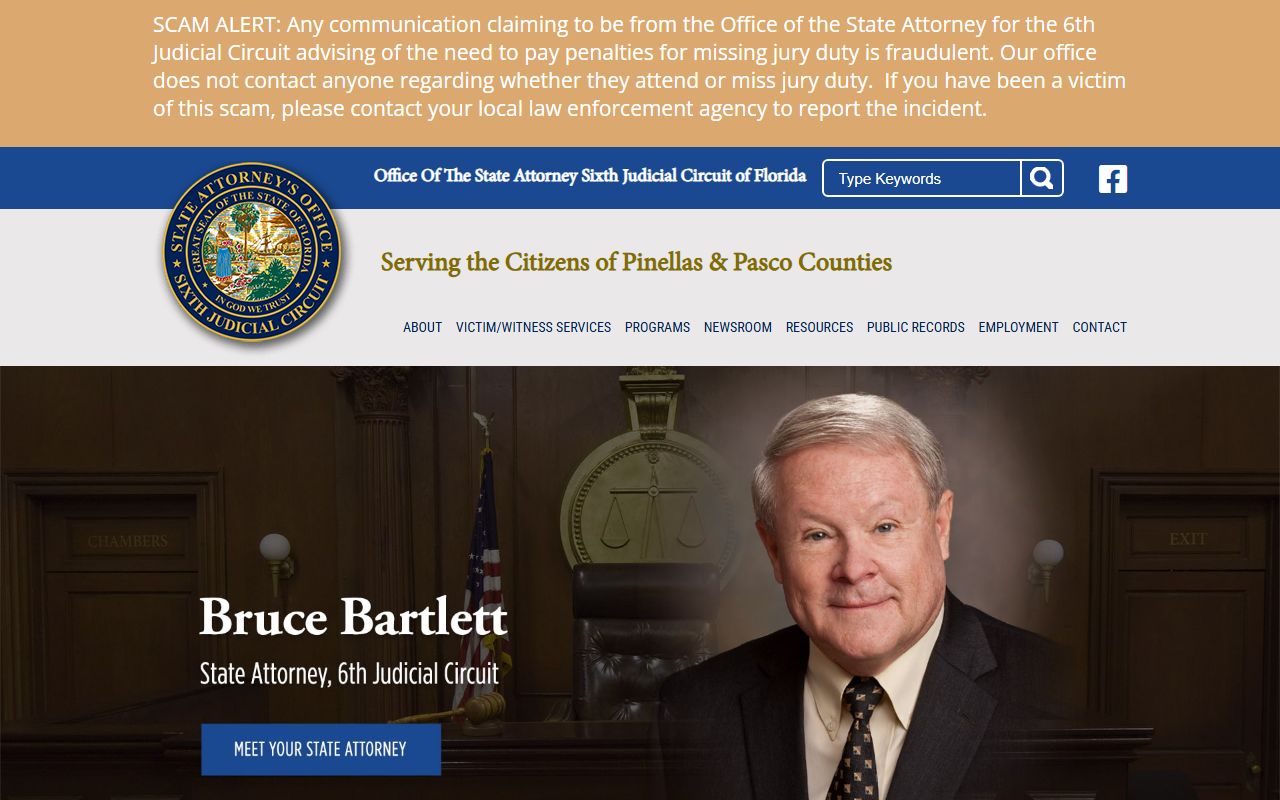
Florida uses State Attorneys rather than county district attorneys, so the office that files charges here is the Sixth Judicial Circuit State Attorney. Its public-records custodian handles requests for prosecutor review files, separate from the court docket the Clerk keeps.
How Charges Get Filed After an Arrest: Complaint, Information, and Indictment
The charge record begins with a charging document. After the booking at the jail, the prosecutor files one of three main types, and the type depends on the offense. Most Pasco felony and misdemeanor prosecutions begin with an Information filed by the State Attorney. A grand-jury Indictment is used for the most serious cases, and the Sixth Circuit notes the indictment path for first-degree murder.
| Complaint | Information | Indictment | |
|---|---|---|---|
| Filed By | Officer / Prosecutor | State Attorney | Grand Jury |
| Common For | Initial charges at arrest | Many felonies and misdemeanors | Serious felonies |
| Starts | The early stage | The court case | The court case |
Charge Status in Court Records After an Arrest
Charges change as a case moves through court. The prosecutor may file the arrest charges as written, amend them, reduce them, add counts, or drop them. This is why the booking charges on the jail roster can differ from the charges in the court record after an arrest. The common status terms appear below.
| Status | What It Means |
|---|---|
| Pending | The case is open and no final result has been entered. |
| Amended / Reduced | The prosecutor changed a charge to a different or lesser count. |
| Dismissed | A charge was dropped by the court and is no longer pursued. |
| Nolle Prosequi | The prosecutor formally chose not to pursue the charge. |
Note: A roster charge can show a docket number before the case is easy to find in the court search, so if a search returns nothing, wait for indexing or contact the Clerk.
Bond and Release After a Pasco County Arrest
At a first appearance, a judge sets release conditions. A judge may grant release on recognizance, set a monetary bond, add supervised conditions, or order no bond. A surety bond is posted through a licensed bail agent, while a cash bond is posted in full. The Pasco Clerk's materials explain that surety bonds are arranged through a bonding company, not at the Clerk's office, and that a cash bond can be forfeited or applied to unpaid court costs before any refund.
- Cash bond
- The full amount is posted in cash or approved payment, and it can be forfeited or applied to unpaid court costs before any refund.
- Surety bond
- A licensed bail agent posts a bond for a fee, arranged through a bonding company rather than at the Clerk's office.
- Recognizance (ROR)
- Release on a written promise to appear, with no money posted.
- No-bond hold
- A judge's order or another hold blocks release until it is resolved.
A posted bond does not guarantee release if another hold, warrant, sentence, or detainer applies. A cash-bond refund in Pasco requires a refund form and proof of ID, processed through the Clerk's Criminal Collections Unit.
Pasco County Warrants That Lead to an Arrest
An outstanding warrant can lead to a booking and a new court record. The Pasco Sheriff publishes an active-warrants search, and the page carries a safety warning to take no action alone. It says the Fugitive Warrants Unit does not give warrant information by phone and directs a person to surrender at the Pasco County Central Jail at 20101 Central Blvd in Land O' Lakes. Final case disposition is checked with the Clerk, not the warrant page. A statewide fallback is the FDLE wanted-persons search, which FDLE cautions is reported information, not confirmation a warrant is still active. Once a warrant arrest leads to a booking, the case appears in the court record after that arrest.
Tracking Court Dates and Case Updates
After charges are filed, court dates drive the case. Florida Courts E-Notify lets a person sign up for alerts about scheduled court events, and Pasco Corrections links it from its own pages. VINELink covers custody-status alerts on the jail side. Neither replaces the official docket the Clerk keeps, but both help an interested person follow what happens after an arrest. For certified copies or sealed-file questions, the Clerk is the office to contact.
Charges vs. Convictions in Pasco County Court Records
Being arrested and charged is not the same as being convicted. A charge is an accusation that opens a case. A conviction is a verdict or plea entered at the end. Both can appear in public court records, but they sit at different stages and carry very different weight.
| Charge | Conviction | |
|---|---|---|
| Stage | Accusation | Verdict or plea |
| Burden of Proof | Probable cause | Beyond a reasonable doubt |
| Public Record | Yes | Yes |
Sealed vs. Expunged Court Records
Florida law lets some people seal or expunge a qualifying record after an eligible disposition. Sealing keeps the record from public view, while expunction goes further and treats the record as destroyed. The state process runs through FDLE, and the statutes are linked below. Sealing or expunging a court record does not mean a private website can erase every copy elsewhere.
| Sealed | Expunged | |
|---|---|---|
| Visibility | Hidden from public view | Destroyed and treated as never existing |
| Law Enforcement | Limited access | Very limited access |
| Florida Statute | § 943.059 | § 943.0585 |
Pasco County Court Copy Fees and Requests
Viewing court records on a public computer is free, and so is a computer records search. Copies and certified records carry set fees from the Clerk. A document copy is $1 per page, certification is $2 per document, and an assisted search is $2 per name per year. An authenticated or exemplified certificate is $7, and a sealing or expungement filing-related fee is $42. Card payments add a 3.5% transaction fee. Some documents are barred by law from being copied, and sealed or expunged files are handled separately.
Important: This is a private reference site and not a consumer reporting agency, so nothing here may be used for employment, tenant, credit, or other FCRA-covered screening.
Restricted Court Records After an Arrest in Pasco County
Not every court record after an arrest is open. Juvenile matters, sealed and expunged cases, and certain victim and witness information are limited or withheld under Florida law and court access rules. Online access to the court index is also governed by Florida Supreme Court administrative order and depends on the user's role, which is why attorneys of record can request enhanced access the general public does not get. When a record is restricted, the Clerk explains what is releasable and what requires a court order.
Older case files may not be fully online. Pasco keeps records-retention facilities in Dade City and New Port Richey, and the Clerk's public-records liaison handles files that are not searchable through the portal. A request for an older or certified court record goes to the Clerk, while a request for the prosecutor's review file goes to the State Attorney's public-records custodian. Knowing which office holds the record speeds up the answer.